

How Much Does Spray Foam Insulation Cost in Georgetown?
Our Spray Foam Insulation services in Georgetown, TX typically cost between $1,800 and $6,500 for a residential job, depending on the area being insulated, the type of foam used, and whether air sealing is completed first. Open-cell foam runs roughly $0.44 to $0.65 per board foot, while closed-cell foam runs $1.00 to $1.50 per board foot in the current Georgetown market. Most homeowners in Sun City, Wolf Ranch, and the older neighborhoods east of I-35 land somewhere between $2,200 and $4,800 for a full attic or crawl space application.
If you want a written price before anyone shows up – not an estimate that shifts after the fact – that is exactly how we operate at Envelope Insulation Co. under the Haven Standard. Every job starts with a flat written price and a written scope. No surprises on the invoice.
Spray Foam Insulation Cost Breakdown (2026)
Spray foam insulation pricing breaks down by application type, square footage, and foam thickness required. The table below reflects actual Georgetown-area pricing as of 2026, not national averages pulled from a pricing database in another climate zone.
| Application | Foam Type | Typical Georgetown Price Range |
|---|---|---|
| Attic roof deck (1,200 sq ft) | Open-cell, 5-6 inches | $2,000 – $3,200 |
| Attic roof deck (1,200 sq ft) | Closed-cell, 3-4 inches | $3,400 – $4,800 |
| Crawl space walls and rim joists | Closed-cell, 2-3 inches | $1,400 – $2,600 |
| Garage ceiling (400-600 sq ft) | Open-cell or closed-cell | $900 – $1,800 |
| Rim joist sealing only | Closed-cell, 2 inches | $400 – $900 |
| Exterior wall cavities (retrofit, per room) | Open-cell via injection | $600 – $1,400 |
| New construction full envelope (2,000 sq ft home) | Mixed open/closed-cell | $5,500 – $9,800 |
| Air sealing prep (top plates, penetrations, can lights) | Two-part closed-cell foam and mastic | $350 – $850 |
A few things worth knowing about those numbers. First, Georgetown sits in IECC Climate Zone 2, which means building codes call for higher R-values than you’d need in, say, a climate zone 4 state. To hit code-required R-38 in an attic using closed-cell foam, you need roughly 6 inches of product – more material, more labor, higher cost. Second, Georgetown’s soil shifts. The clay-heavy ground in areas like Reata Trails and Parkside at Mayfield Ranch causes foundation movement that cracks drywall and opens up penetrations in attic floors over time. We see this constantly. An attic that looked sealed when a house was built in 2018 often has measurable air leaks by 2024. That means air sealing is not optional before insulating – it’s the only way to make the spray foam dollar actually work.
At Envelope Insulation Co., air sealing of top plates, can lights, and all penetrations is completed before any insulation goes in. That sequence – sealed first, then insulated – is not an upsell. It’s the standard. On applicable jobs, we run a blower-door test before and after so you can see, in a single number, how much the air leakage changed.
What Affects Spray Foam Insulation Pricing in Georgetown
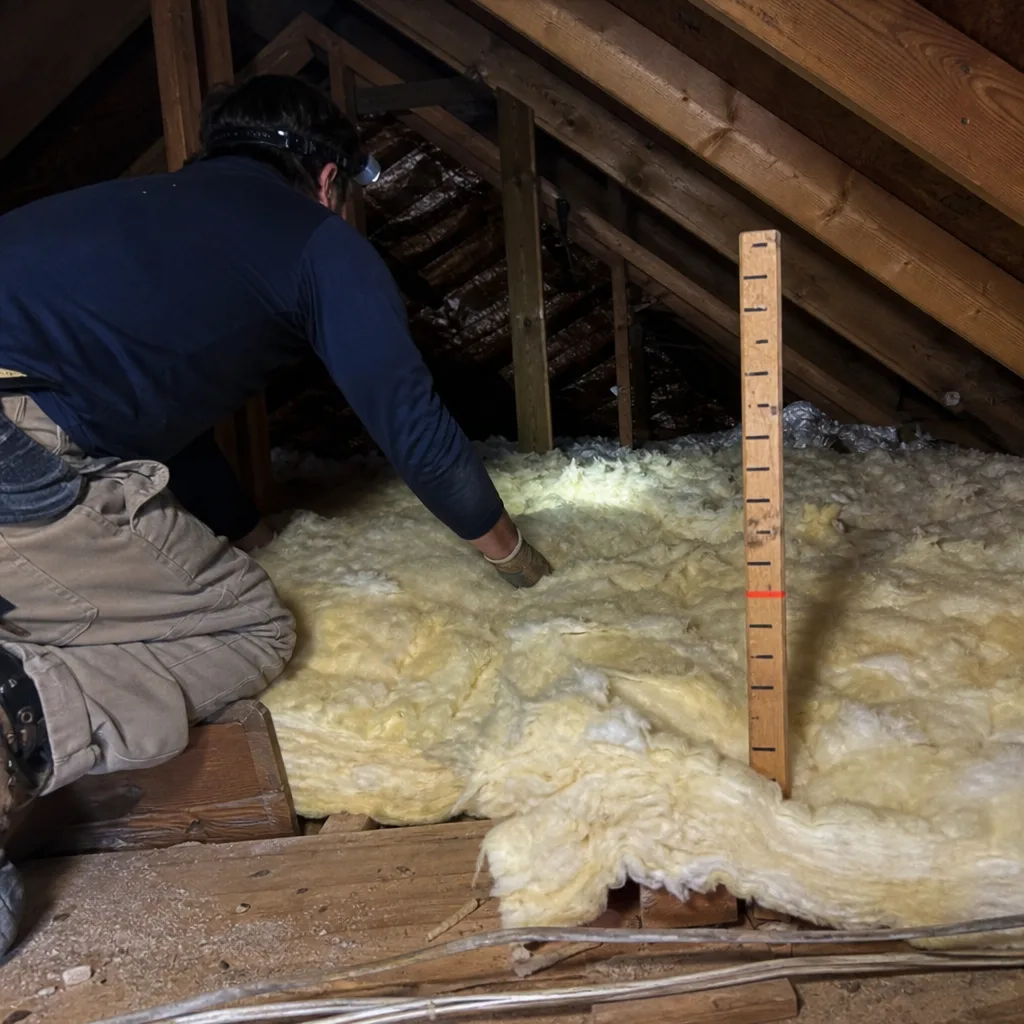
- Open-cell vs. closed-cell foam: Open-cell foam (roughly R-3.7 per inch) is softer, vapor-permeable, and costs about 40-50% less per board foot than closed-cell. Closed-cell foam (roughly R-6.5 per inch) is rigid, acts as a vapor barrier, and is the right call for crawl spaces, rim joists, and anywhere moisture intrusion is a concern – which, given Georgetown’s summer humidity and occasional flooding in low-lying areas near the North Fork of the San Gabriel River, is more locations than most homeowners expect.
- Thickness required to hit the target R-value: Georgetown’s climate zone demands meaningful R-values. Closed-cell foam at 3 inches gives you about R-19. Getting to R-38 requires 6 inches of closed-cell or a hybrid approach – a couple of inches of closed-cell at the roof deck for vapor control, topped with open-cell to hit the R-value target. Hybrid applications cost more in labor but less in materials than going all-closed-cell, and they’re often the right answer for vented-to-unvented attic conversions.
- Attic accessibility and configuration: Georgetown has a wide range of housing stock. A 1990s ranch in Georgetown Village with a simple gable roof and a full-height attic is a different job than a 2022 two-story in Wolf Ranch with a multi-hip roof, multiple HVAC drops, and a finished room over the garage. Tight spaces, kneewall cavities, and obstructions increase labor time and drive price up. We measure every attic before pricing – never guessed square footage.
- Existing insulation removal: If your attic already has compressed fiberglass batts or old blown-in insulation that’s settled to R-8 after 25 years, that material typically needs to come out before spray foam can be applied correctly. Insulation removal in Georgetown runs $800 to $2,200 for a standard attic, depending on depth and access. We document the existing conditions with photos before anything is removed so you can see what you started with.
- Air sealing requirements before foam: Air sealing of the attic floor – top plates, electrical penetrations, recessed can lights, plumbing stacks – needs to be done before insulation is added. In Georgetown homes built between 1995 and 2010, we routinely measure blower-door readings above 5,000 CFM50 before sealing. After sealing and insulating, those same homes often read under 2,500 CFM50. That difference is real money in your electricity bill every month, but the sealing step has a cost: roughly $350 to $850 depending on the number of penetrations. It’s included in our scope pricing – not added as a surprise line item.
- Seasonal demand: Georgetown summers are brutal. Attic temperatures regularly hit 140-160 degrees in July and August, and homeowners notice it on their Oncor electric bills before they notice it anywhere else. Demand for insulation work spikes March through June as homeowners prepare, and again in September when the bills arrive. Scheduling in January through early March or in October and November typically means shorter lead times and the same pricing – we don’t charge more in peak season.
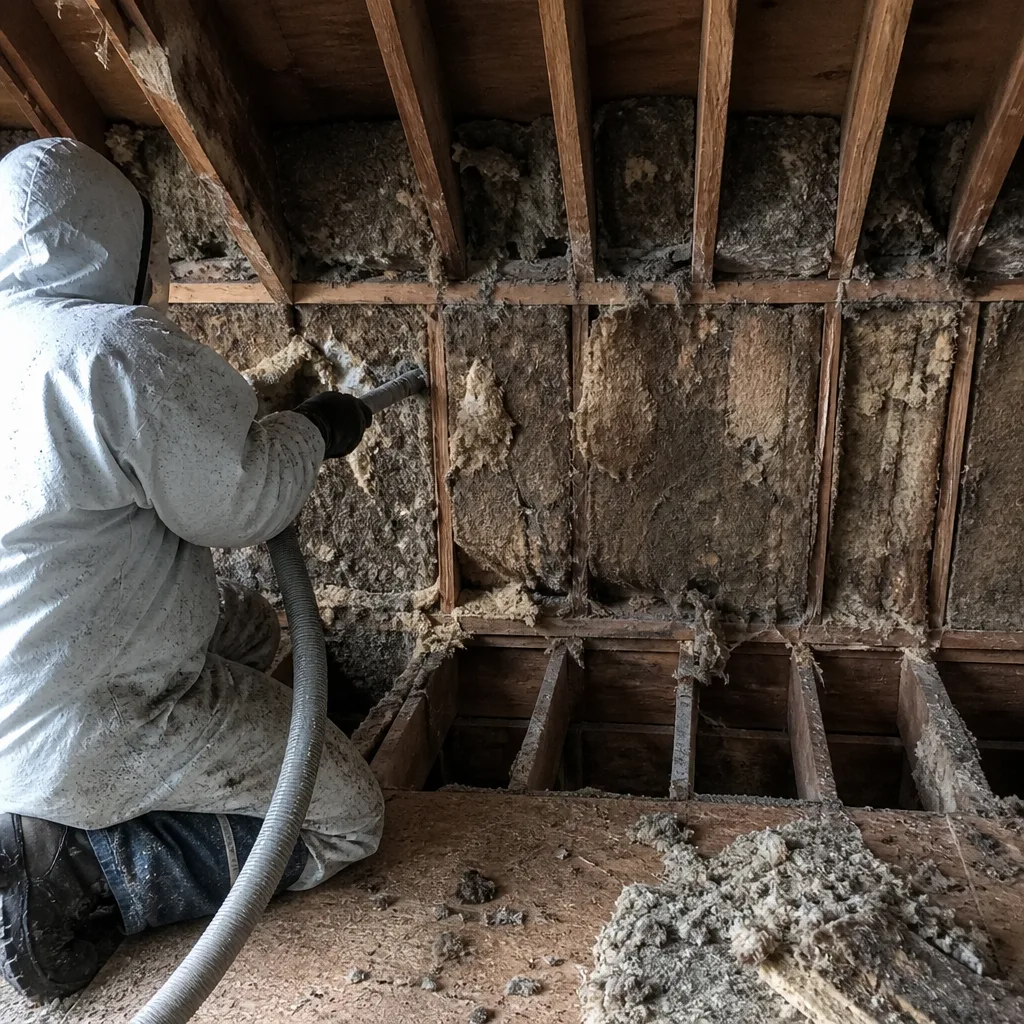 Before
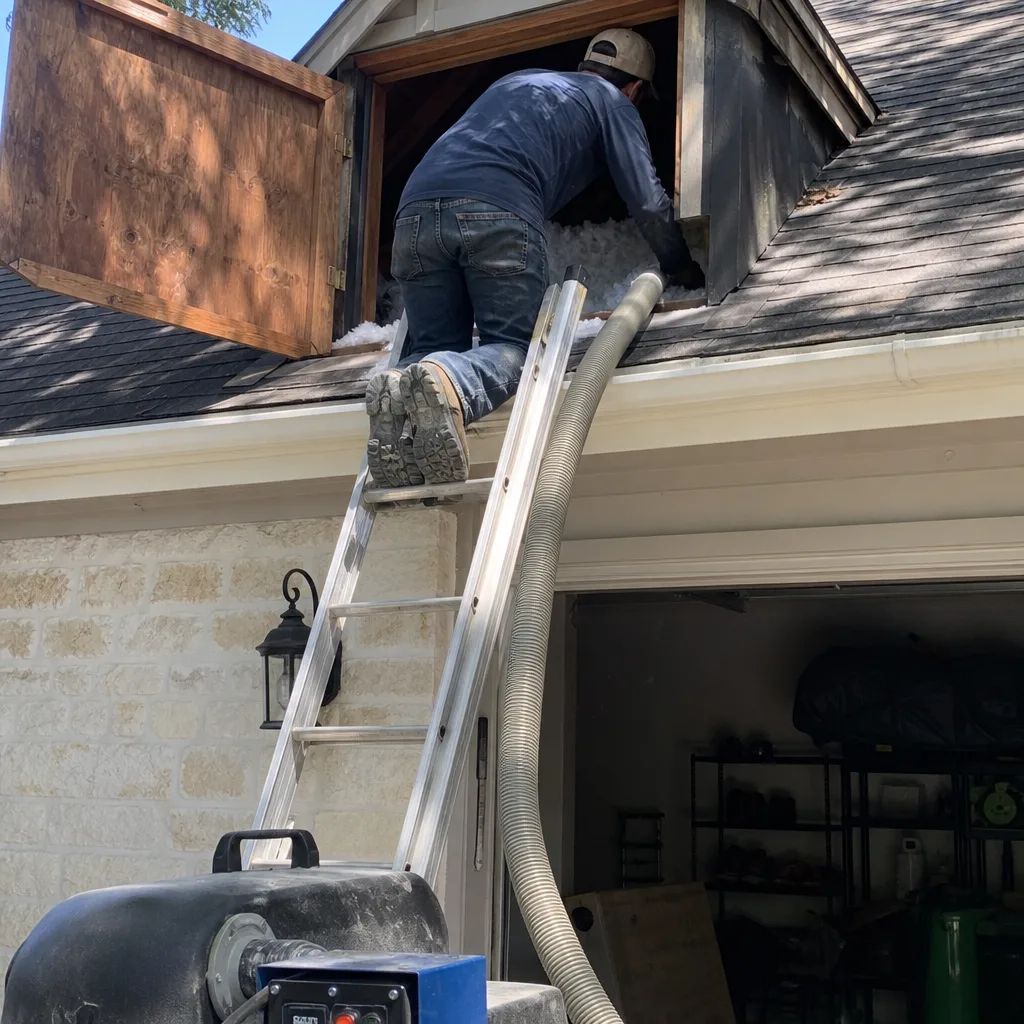 After
AfterHow to Save on Spray Foam Insulation in Georgetown
Get a Blower-Door Test Before You Commit to Any Product
The single most common way Georgetown homeowners overspend on insulation is by buying the wrong product for the actual problem. A blower-door test – a pressurization measurement that shows, in one number, how much conditioned air your home’s building envelope is losing – tells you whether your primary problem is missing insulation or air leakage. In many Georgetown homes built in the late 1990s and early 2000s, the insulation is present but the air sealing was never done. Adding more insulation on top of an unsealed attic floor is like putting a thicker blanket over a window you left open. The test costs far less than the wrong fix.
Consider a Hybrid System Instead of All Closed-Cell
All-closed-cell roof deck applications are sometimes oversold in this market. A hybrid system – 2 inches of closed-cell at the deck for vapor control and air sealing, plus open-cell or blown-in insulation to reach the required R-value – often performs the same on a blower-door reading at 20-30% lower material cost. We’ll tell you when a hybrid is the right answer for your attic configuration, and we’ll put it in writing.
Ask About Utility Rebates Through Your Provider
Georgetown Utility Systems (GUS) and some electric co-ops serving the surrounding Williamson County area periodically offer rebates for qualified insulation upgrades. Rebate availability changes year to year. Before scheduling work, call your provider and ask specifically about air sealing and insulation rebates – not just HVAC rebates. The paperwork typically requires a before-and-after blower-door test, which we document on every applicable job anyway. We don’t file the paperwork for you, but we’ll give you everything you need to file it yourself.
Combine Work When It Makes Sense
If your attic needs air sealing, spray foam at the roof deck, and removal of old fiberglass batts, scheduling those together as one job is cheaper than three separate visits. The setup cost – mobilization, equipment, PPE, crew time – is the same whether the crew does one task or three. We scope the whole job upfront and price it flat. You’ll know the total before we start, not after.
Bring a Competing Written Estimate
We offer a free second opinion on any written estimate from another Georgetown-area contractor. Bring the quote to us and we’ll read it with you line by line – checking for missing scope items like air sealing, verifying that the R-values match what the job actually requires, and flagging anything that looks like it was written to win the bid but not to solve the problem. There’s no charge for that conversation. Call (254) 970-2136 to set one up.
Don’t Buy Foam You Don’t Need
Some Georgetown homes – particularly slab-on-grade ranches in Sun City and Georgetown Village – don’t need spray foam at the attic floor at all. If the goal is an unvented attic (conditioned attic), foam belongs at the roof deck. If the goal is simply adding R-value to a vented attic, blown-in insulation over a sealed attic floor often costs less and performs just as well. Our job is to tell you which approach fits your home, not to sell you the most expensive product we carry. The written scope explains the recommendation. You get to read it and ask questions before anyone starts.
Open-Cell vs. Closed-Cell Spray Foam in Georgetown’s Climate
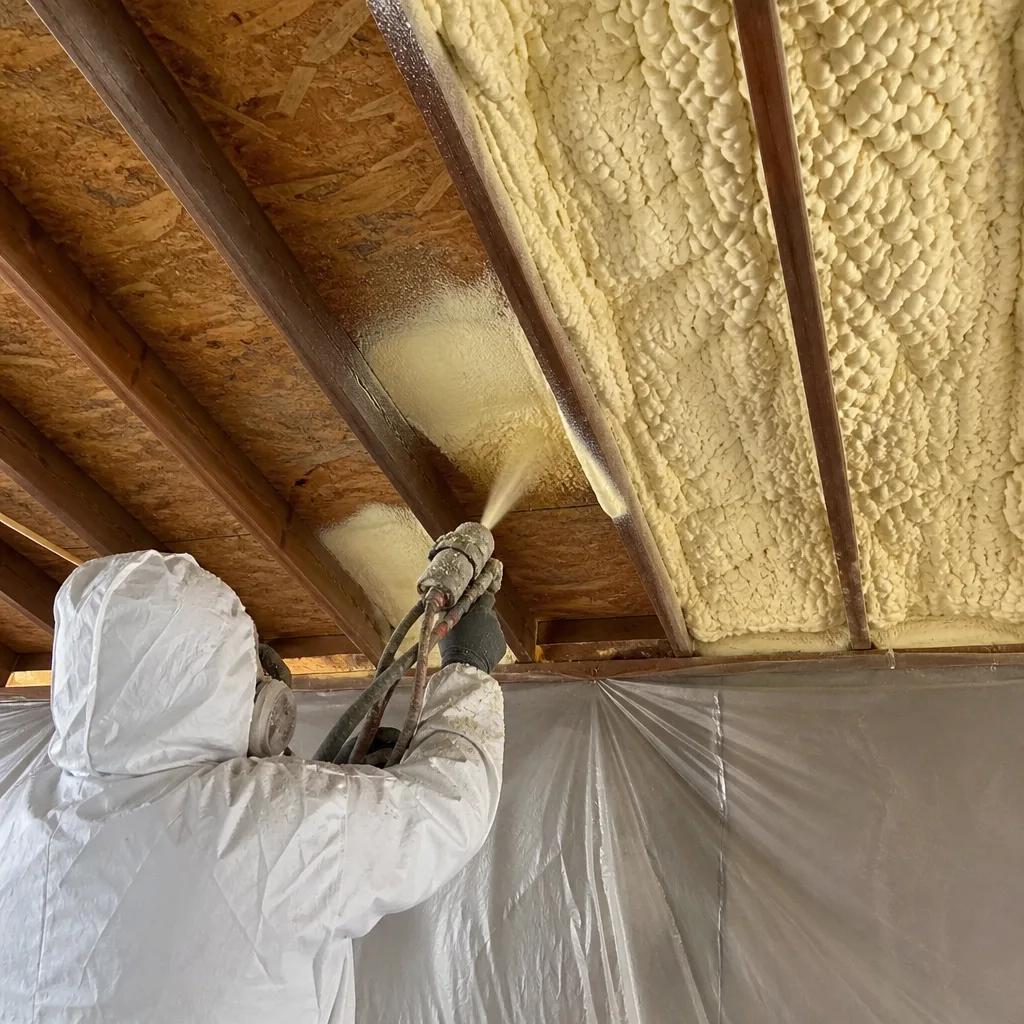
Georgetown sits at the edge of Central Texas where summer humidity from Gulf moisture systems meets intense solar radiation on west- and south-facing roof decks. That combination matters when choosing foam type.
Open-cell foam is vapor-permeable, which means moisture can move through it. In a vented attic application where open-cell is sprayed at the attic floor rather than the roof deck, that’s fine. But in a roof deck application creating an unvented attic, you need a vapor retarder on the interior side if you use open-cell, which adds a step and cost. Closed-cell foam at the roof deck acts as its own vapor retarder – it stops both air and moisture from moving through the assembly. For Georgetown’s climate, closed-cell at the roof deck is the more common and more durable choice for unvented attic conversions.
Open-cell foam makes sense in some applications: interior wall cavities where sound control is as much a priority as thermal performance, and in garage ceilings adjacent to conditioned space where vapor drive is not a concern. It also fills irregular cavities well because it expands to roughly 100 times its liquid volume, versus closed-cell’s 30-40 times.
We use products from Icynene, Demilec, and other manufacturers depending on the application and performance requirements of the specific job. No proprietary product lock-in means we can recommend what actually fits rather than what we happen to have on the truck.
Spray Foam for Specific Georgetown Applications
Vented-to-Unvented Attic Conversions
Many Georgetown homeowners convert a vented attic to an unvented (conditioned) attic when the HVAC equipment or ductwork lives in the attic space. Conditioning the attic means the equipment operates in a space that’s closer to indoor temperature – typically 80-90 degrees in summer instead of 140-160 degrees. The efficiency gain in duct system performance alone often justifies the conversion cost. For a 1,600 sq ft attic in Georgetown, a closed-cell roof deck application for an unvented conversion typically runs $3,800 to $5,600 fully installed, including air sealing of all gable vents and soffit vents that get closed off.
Crawl Spaces Under Older Georgetown Homes
Georgetown has a meaningful stock of older homes with vented crawl spaces, particularly in the downtown and Old Town areas near the courthouse square. Closed-cell spray foam at 2 inches on the crawl space walls and rim joists creates a semi-conditioned crawl space, reducing moisture and the freeze-thaw stress on pipes during the occasional hard freeze Georgetown gets in January and February. Crawl space foam jobs in Georgetown typically run $1,400 to $2,600 depending on linear footage and accessibility.
New Construction in Georgetown’s Growing Subdivisions
Georgetown is one of the fastest-growing cities in Texas, and subdivisions like Wolf Ranch, Parkside at Mayfield Ranch, and Morningstar are putting up new homes at a significant pace. New construction spray foam – typically a hybrid open/closed-cell system for the full building envelope – runs $5,500 to $9,800 for a 2,000 sq ft home in the current Georgetown market. Builders who spec foam rather than fiberglass batts typically see HERS score improvements significant enough to affect mortgage qualification under some green lending programs. We work directly with builders and can provide the documented blower-door results required for those programs.
What a Spray Foam Job With Envelope Insulation Co. Looks Like
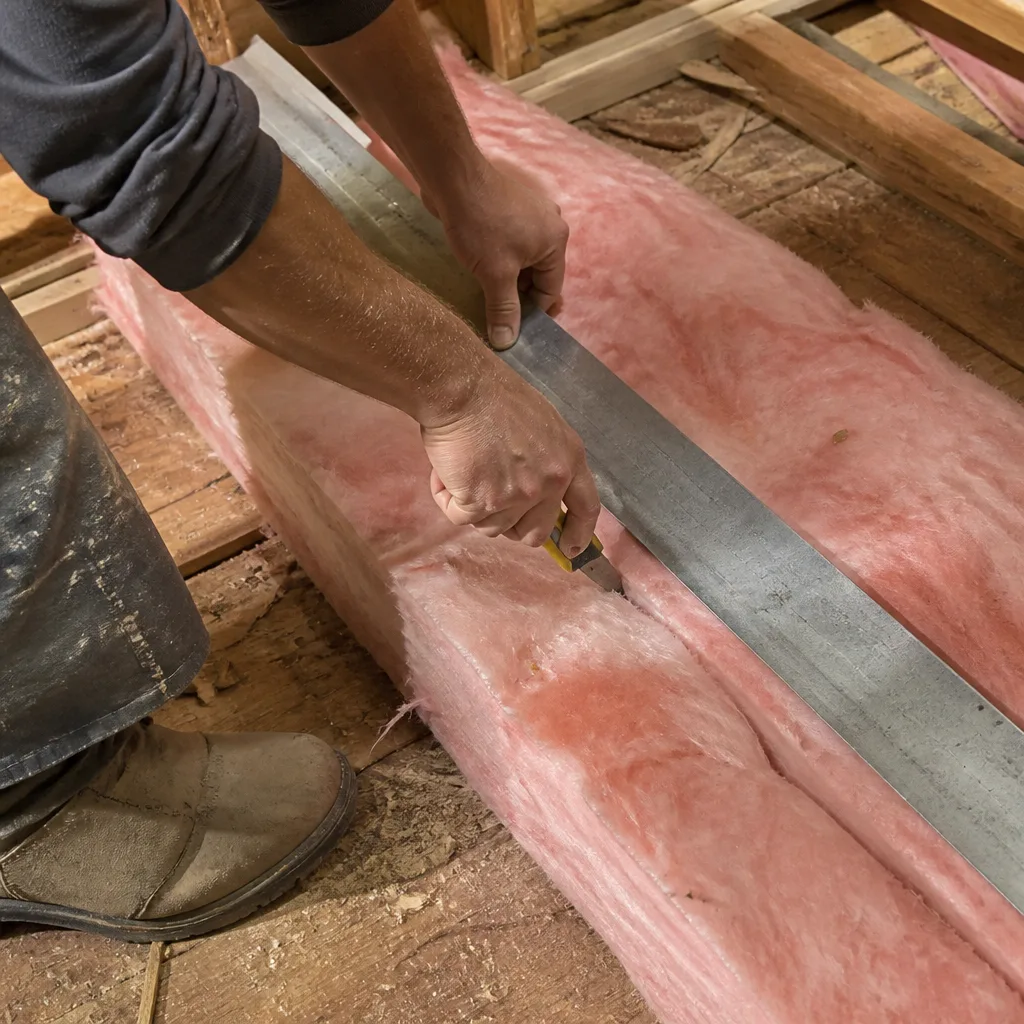
Before any work starts, you receive a written price, a written scope of work, and a written warranty. That’s not a selling point – it’s Haven Standard Clause 1. The scope describes exactly what surfaces get foam, what thickness, what R-value, and what the air sealing prep includes.
The technician who shows up is background-checked, uniformed, and named before arrival. You’ll get a text when they’re on the way. When the job is complete, you receive a documented photo record of the work – before-condition photos and after-condition photos – so there’s a permanent record of what the attic looked like when we arrived and what it looked like when we left. On applicable jobs, you also receive before-and-after blower-door readings: two numbers that show you exactly how much the air leakage changed. Not an estimate of the improvement. The measured result.
Wes Okafor leads the team at Envelope Insulation Co. and has built the entire operation around the principle that a homeowner should never have to wonder what they actually paid for. Every job in Georgetown – from a simple rim joist seal to a full roof deck conversion in a Wolf Ranch two-story – closes with documentation you can pull out and look at in five years.
The 365-Day Done Right Promise applies to every completed job. If something isn’t right within 365 days of the completed work, we make it right. That commitment is in writing before work starts, not offered after the fact.
Across more than 9,000 homes sealed and insulated since 2016, the standard has been the same: written price, written scope, written warranty, documented record. Our Spray Foam Insulation in Georgetown service page covers the full technical details of what each application involves if you want to read further before calling.
FAQs – Spray Foam Insulation Cost in Georgetown, TX
How much does spray foam insulation cost per square foot in Georgetown?
Open-cell spray foam in Georgetown runs approximately $0.44 to $0.65 per board foot (a board foot equals one square foot at one inch thick). Closed-cell foam runs $1.00 to $1.50 per board foot. A 1,200 sq ft attic roof deck sprayed with 5 inches of open-cell foam would use 6,000 board feet, putting the material-plus-labor cost roughly in the $2,600 to $3,900 range for that application alone. Total job cost depends on what thickness you need to hit your target R-value and whether air sealing prep is included in the scope – which it should be. Call (254) 970-2136 and we’ll put a flat written price on your specific job before anyone shows up.
Is spray foam worth it in Georgetown’s climate?
For most Georgetown homes where the HVAC equipment or ductwork is in the attic, yes – spray foam at the roof deck typically pays back in reduced cooling costs within 4 to 8 years, depending on your current attic conditions and the size of your system. Georgetown’s summer heat loads are severe; attic air temperatures regularly reach 150-160 degrees from June through September, and conditioned air leaking through an unsealed attic floor works directly against every dollar your HVAC system spends. The payback calculation changes if your ducts are already in conditioned space, in which case blown-in insulation over a sealed attic floor may perform similarly at lower cost. We’ll tell you which scenario fits your home when we assess it.
How much does it cost to insulate a 1,500 sq ft attic with spray foam in Georgetown?
A 1,500 sq ft attic roof deck application in Georgetown runs approximately $2,500 to $4,200 for open-cell foam at code-appropriate thickness and $4,200 to $6,000 for closed-cell foam at equivalent R-value. If the attic floor needs air sealing first – which it almost certainly does in any Georgetown home built before 2015 – add $400 to $850 for that prep work. Those ranges reflect current Georgetown-area labor and material costs, not national averages. Your exact number depends on attic geometry, accessibility, and current insulation conditions. Call (254) 970-2136 for a written price specific to your home.
Can I get spray foam insulation done on a vented attic, or does it have to be an unvented conversion?
Spray foam in a vented attic is applied at the attic floor, between and over the ceiling joists, sealing penetrations and creating a thermal boundary at the ceiling plane while leaving the attic space itself vented to the outside. Spray foam in an unvented attic conversion is applied at the roof deck (the underside of the roof sheathing), which moves the thermal boundary up to the roofline and conditions the attic space itself. Both are valid approaches – the right one depends on whether your HVAC equipment and ductwork live in the attic. If they do, an unvented conversion typically makes more sense. If your ducts are in conditioned space already, a sealed-and-insulated attic floor may be the better call. We’ll assess your attic configuration and explain the recommendation in writing before any work starts.
Does Envelope Insulation Co. offer financing or payment options for Georgetown spray foam jobs?
We don’t offer in-house financing, and we won’t promise a program we can’t guarantee is available when you’re ready to schedule. What we do offer is a flat written price before anyone starts, which means you know the full number upfront with no scope creep, and a free second opinion on any competing written estimate so you can verify you’re comparing equivalent scopes. If you have a written quote from another Georgetown contractor, bring it to us and we’ll read it with you at no charge. Call (254) 970-2136 to set that up or to get your own written estimate started.
What is a blower-door test and do I need one before getting spray foam?
A blower-door test is a pressurization measurement – technicians mount a calibrated fan in your front door, depressurize the house to a standard level (50 Pascals), and measure how much air flows through the fan to maintain that pressure. The result is a single number in CFM50 (cubic feet per minute at 50 Pascals) that tells you, precisely, how leaky your building envelope is. In Georgetown homes we’ve tested before sealing, readings above 5,000 CFM50 are common. After sealing the attic floor and major penetrations, those same homes often read 2,200 to 2,800 CFM50. The blower-door test isn’t required before spray foam, but it is the only honest way to verify what the air sealing work actually accomplished – which is why we include before-and-after readings on applicable jobs rather than asking you to take our word for the result.
Key Takeaways
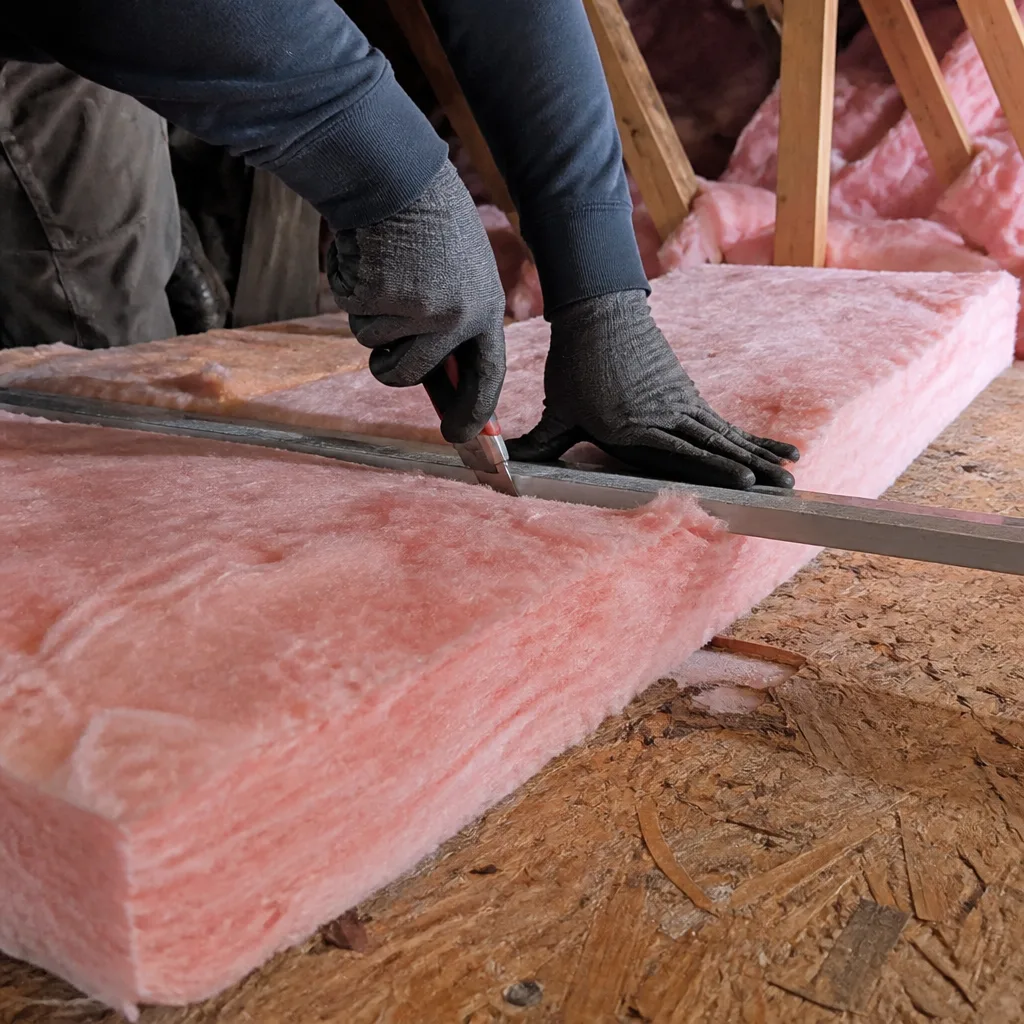
- Spray foam insulation in Georgetown, TX costs between $1,800 and $6,500 for most residential applications in 2026, with closed-cell foam running roughly twice the per-board-foot cost of open-cell.
- Georgetown’s IECC Climate Zone 2 requirements, shifting clay soils, and extreme summer attic temperatures make air sealing before insulating a hard requirement – not an optional add-on.
- A hybrid closed-cell/open-cell system often hits the same R-value target as all-closed-cell at 20-30% lower cost.
- Every Envelope Insulation Co. job in Georgetown starts with a flat written price and ends with a documented photo record. On applicable jobs, before-and-after blower-door readings are included so you can verify the result.
- The 365-Day Done Right Promise applies to every completed job – in writing, before anyone starts.
- Wes Okafor and the Envelope Insulation Co. team have completed the same written-price, documented-record process on more than 9,000 homes since 2016.
- Bring any competing written estimate to us for a free second opinion – we’ll read it with you line by line.
Get a Written Price for Your Georgetown Home
If you’re trying to figure out whether spray foam makes sense for your attic, your crawl space, or a specific area of your home, the fastest way to get a real answer is a site assessment and a written price. Not a range pulled from a national database. A flat number, scoped to your home, in writing, before anyone touches anything.
We serve Georgetown and the surrounding Williamson County area – Sun City, Wolf Ranch, Georgetown Village, Reata Trails, Parkside at Mayfield Ranch, Morningstar, Old Town, and every subdivision in between. A live person answers when you call, any time of day. Learn more about our work at the home page or go straight to our Spray Foam Insulation in Georgetown page if you want the full technical overview before reaching out.
Call (254) 970-2136 to schedule a free estimate. You’ll get a written price before any work starts – that’s not a promise we make for marketing reasons. It’s how every single job works, without exception.
Pricing reflects the Georgetown, TX market as of 2026. Written by Wes Okafor, owner at Envelope Insulation Co. (operating as Topside Attic Insulation Georgetown), independently owned and operated under The Haven Standard since 2016, serving Georgetown and Williamson County.
What Our Customers Say
"They photographed rodent damage in the old insulation that we had no idea about, and priced the exclusion work separately so we could decide."
- Harriet N."Crawl space encapsulation done properly. Photographs of the vapour barrier at every seam, and the damp smell in the hallway is gone."
- Ainsley P."Fixed price, clean work, and they hauled the old material away as agreed."
- Todd M.