
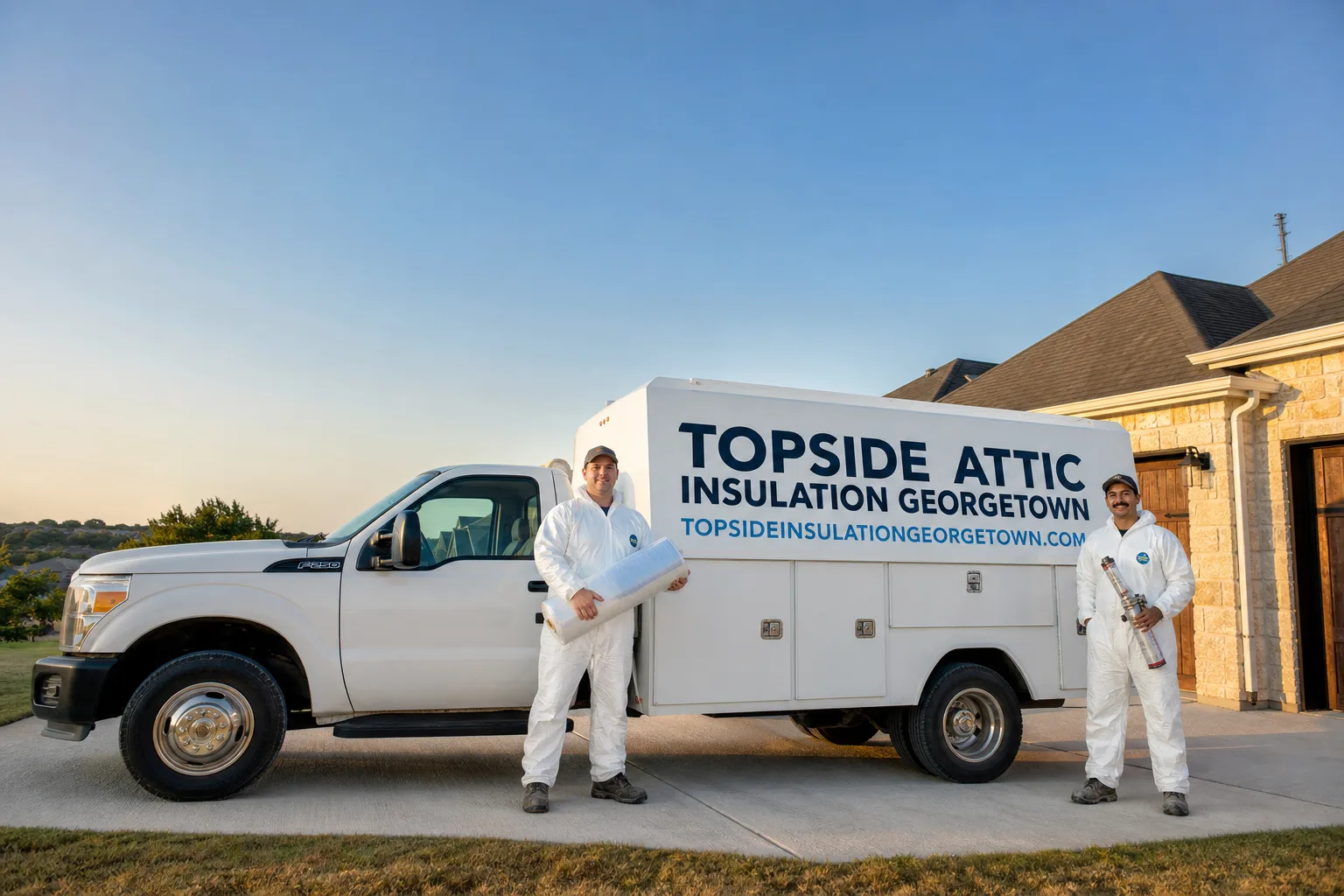
How Much Does Wall Insulation Cost in Georgetown, TX?
Wall insulation in Georgetown, TX typically runs between $1.50 and $4.25 per square foot of wall area, depending on the method used, the accessibility of the wall cavities, and whether air sealing is done first. For a 2,000-square-foot Georgetown home with roughly 1,200 square feet of exterior wall area, most homeowners pay between $1,800 and $5,100 installed – before any utility rebates. Same-day written pricing is available; there is no need to call around for ballpark numbers that don’t commit to anything.
Wall Insulation Cost Breakdown (2026)
The table below reflects installed costs in the Georgetown market as of early 2026. “Installed” means material plus labor, with air sealing of electrical boxes, top plates, and penetrations completed before insulation goes in – because at Envelope Insulation Co., air sealing is a prerequisite, not an add-on line you can delete to save $200.
| Insulation Type | Typical Method | Installed Cost per Sq Ft (Wall Area) | 1,200 Sq Ft Wall Estimate |
|---|---|---|---|
| Dense-pack cellulose (blown-in) | Small drill holes in drywall or siding; holes patched | $1.80 – $2.80 | $2,160 – $3,360 |
| Dense-pack fiberglass (blown-in) | Same drill-and-fill method | $1.90 – $2.90 | $2,280 – $3,480 |
| Open-cell spray foam | Requires open wall cavity (new construction or gut renovation) | $2.25 – $3.50 | $2,700 – $4,200 |
| Closed-cell spray foam | Requires open wall cavity; highest R-value per inch | $3.00 – $4.25 | $3,600 – $5,100 |
| Batt fiberglass or mineral wool (retrofit) | Open wall required; often paired with a remodel | $1.50 – $2.40 | $1,800 – $2,880 |
| Air sealing only (before insulation) | Foam, caulk, fire-rated sealant at penetrations | $0.35 – $0.75 | $420 – $900 |
A few things worth spelling out. The “1,200 sq ft wall area” figure assumes a typical two-story Georgetown home built between 2000 and 2018, where exterior wall area usually falls between 900 and 1,500 square feet once you subtract windows and doors. Homes in the Wolf Ranch and Morningstar neighborhoods tend to run on the higher end of that range because of their larger footprints and two-story layouts. Older homes in the Historic Downtown Georgetown corridor – some built in the 1920s and 1930s – often have balloon-frame construction, which changes the drilling pattern and adds time, typically pushing labor costs 15-20% above the ranges shown.
What drives cost up? Inaccessible cavities (brick veneer over masonry ties, for example), discovery of existing deteriorated insulation that needs to come out first, and homes where prior pest damage has compacted or contaminated whatever was already there. Homes in the Teravista and Berry Creek areas that back to the Brushy Creek corridor can show evidence of moisture intrusion in wall cavities – something our blower-door test and visual inspection will flag before we quote, not after.
What drives cost down? Homes with vinyl siding where the siding can be temporarily lifted rather than drilling through the exterior – that eliminates patching costs. Homes where a remodel is already planned and studs are exposed. And jobs where the scope is clearly defined up front, which is why a written price before work starts saves everyone time.
What Affects Wall Insulation Pricing in Georgetown
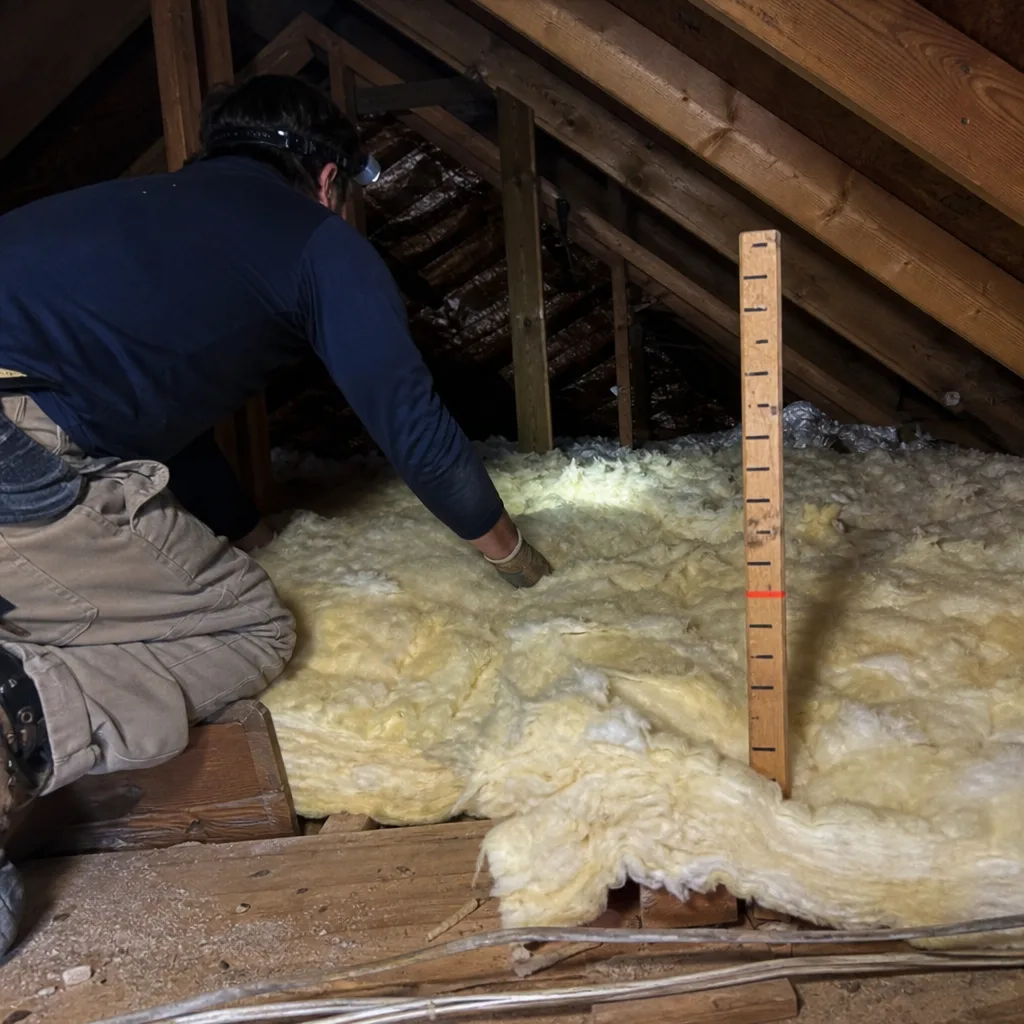
- Wall construction type: Georgetown’s housing stock spans wood-frame 2×4 construction (pre-1995), 2×6 framing (common in newer Sun City and Wolf Ranch builds), brick veneer, and – in a handful of older properties near the Square – solid masonry. Brick veneer homes almost always require the drill-and-fill method from the interior, which adds patching. Solid masonry walls are a different project category entirely and priced separately on inspection.
- Insulation method chosen: Dense-pack blown-in is the standard retrofit choice in Georgetown because it avoids opening walls. Spray foam – either open-cell or closed-cell – produces the highest R-value per inch and adds structural stiffness, but it requires an open cavity, so it fits best into new construction or a gut renovation. The right method depends on what your walls currently have in them and what the blower-door numbers say about where your air losses are concentrated.
- Current insulation condition: Homes built in Georgetown before 1985 frequently have little to nothing in exterior walls, or they have degraded fiberglass batts that have slumped and lost their R-value. If existing material is contaminated – from a roof leak that tracked down a wall, or from a rodent infestation – it has to come out before anything new goes in. Removal adds $0.50 to $1.20 per square foot to the project.
- Georgetown’s climate and its effect on wall performance: Williamson County sits in IECC Climate Zone 2A – hot-humid. That means walls face both high summer heat loads (July and August surface temperatures on south- and west-facing walls regularly exceed 140°F) and periodic winter cold snaps that create condensation risk when warm interior air meets a cold cavity. Material selection matters here: closed-cell foam acts as its own vapor retarder, which is one reason it’s specified more often in Georgetown than in drier Central Texas markets.
- Linear feet of air sealing required: Air sealing is priced separately from insulation and completed first. A typical Georgetown home has 150 to 300 linear feet of top-plate penetrations, electrical boxes, and duct chases that need to be sealed before blown-in insulation goes in. Skipping this step and blowing insulation over an unsealed wall cavity is something Envelope Insulation Co. does not do – the air sealing is completed, documented, and photographed before any insulation material is loaded into a machine.
- Story height and access: Single-story ranch homes common in Georgetown’s older Serenada and Reata Trails neighborhoods are generally faster to work on than two-story homes with cathedral ceilings or dormers. Jobs where scaffolding is required for exterior access – rare but it does happen – carry a day-rate equipment surcharge, which will be listed explicitly in the written price.
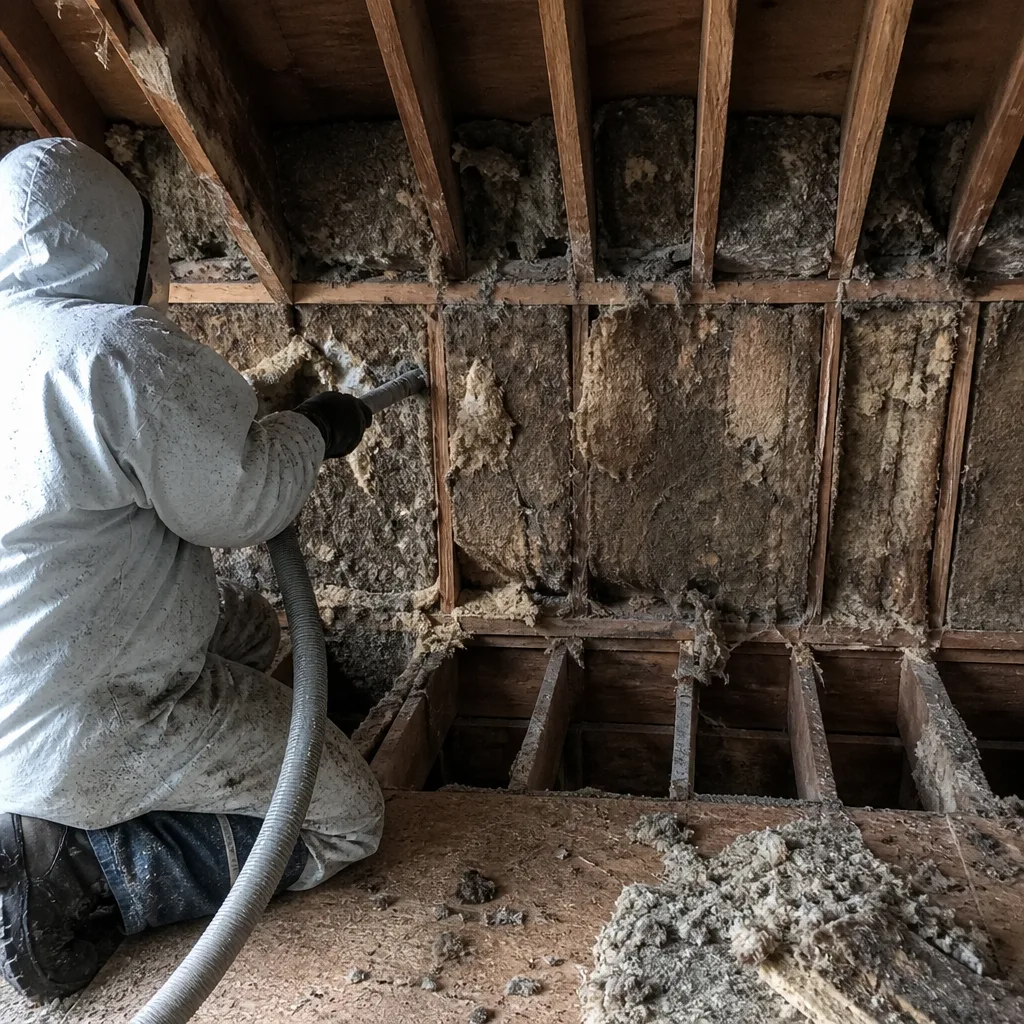 Before
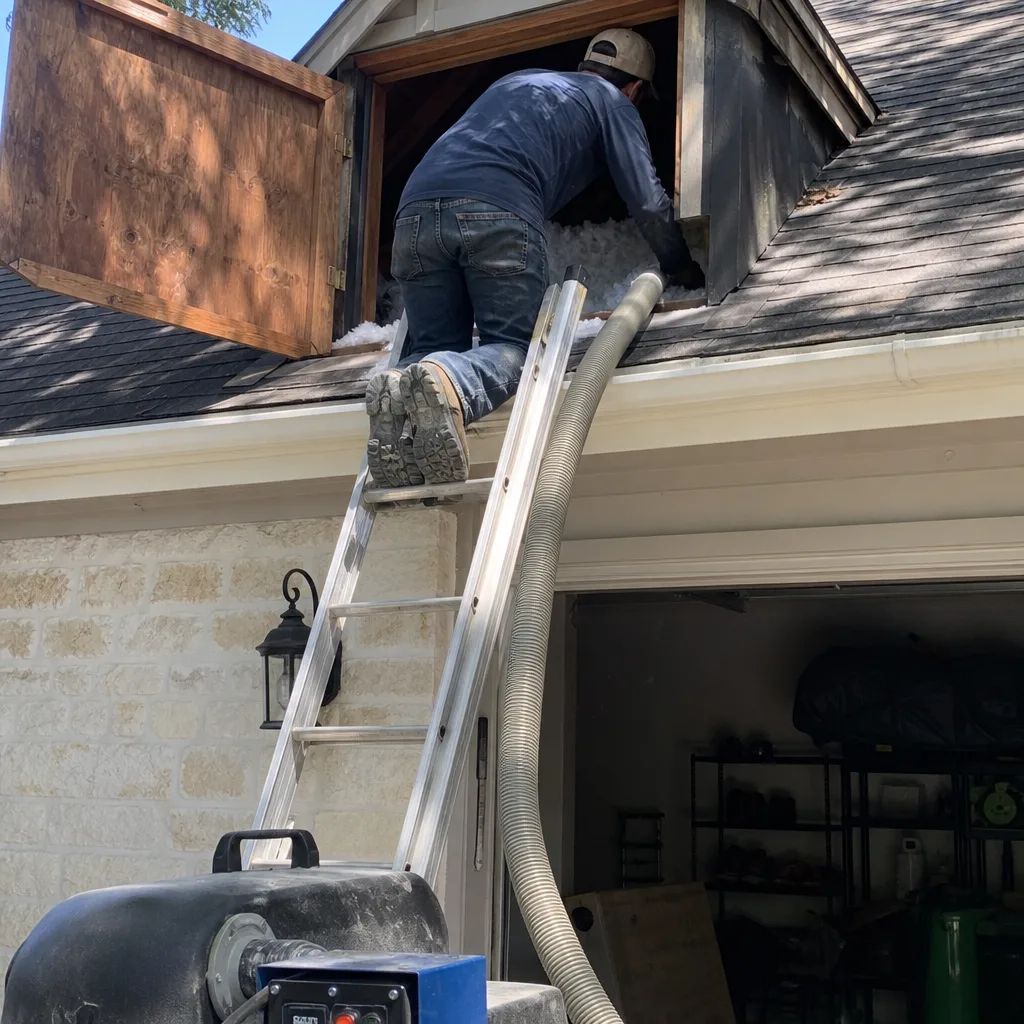 After
AfterBatt vs. Blown-In vs. Spray Foam: Which Makes Sense in Georgetown?
This question comes up on almost every estimate in Georgetown, so it’s worth answering directly rather than routing it to a sales call.
Dense-pack cellulose or fiberglass blown-in
This is the right answer for most existing Georgetown homes that don’t have a remodel underway. The installer drills 2- to 2.5-inch holes in a grid pattern – either through the drywall from the interior or through the exterior sheathing – fills each cavity under pressure to approximately 3.5 lb/ft3, and patches the holes. Done correctly, dense-pack achieves R-13 in a 2×4 wall and R-20 in a 2×6 wall, and the packed density essentially eliminates convective looping inside the cavity. Cellulose (GreenFiber is one brand we use regularly) has a slight edge on settling resistance; fiberglass (Knauf or Johns Manville) has a slight edge in humid wall assemblies. The blower-door reading after the job shows whether the air sealing step did its job.
Spray foam
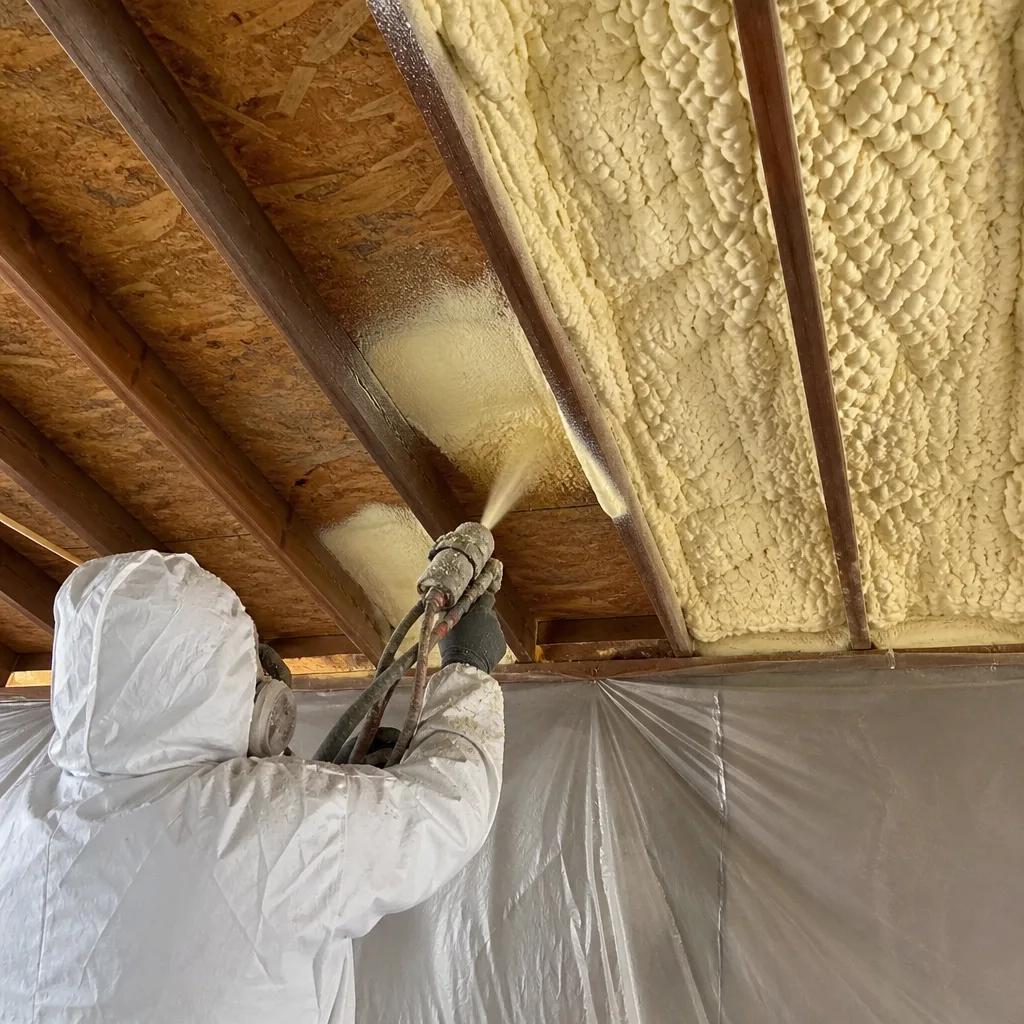
Open-cell spray foam from Icynene or Demilec fills every void and crevice in a wall cavity and doubles as an air barrier without a separate sealing step. Closed-cell adds a vapor retarder and meaningful racking strength. Both require an open wall. If you’re already planning a kitchen or bathroom renovation that means open studs, spray foam is worth serious consideration because you won’t get that access again cheaply. If walls are closed, blown-in is the practical choice.
Fiberglass or mineral wool batts
Rockwool and CertainTeed batts work well in open walls during new construction or major renovation. Retrofitting them into an existing home means opening the walls, which usually makes them the most expensive option per unit of R-value once drywall repair is factored in. They’re not a common retrofit choice in Georgetown, but they’re the right answer when the wall is already open and you want a non-combustible option near a fireplace chase or mechanical room.
The Air Sealing Step – Why It’s Listed Separately and Why It Matters
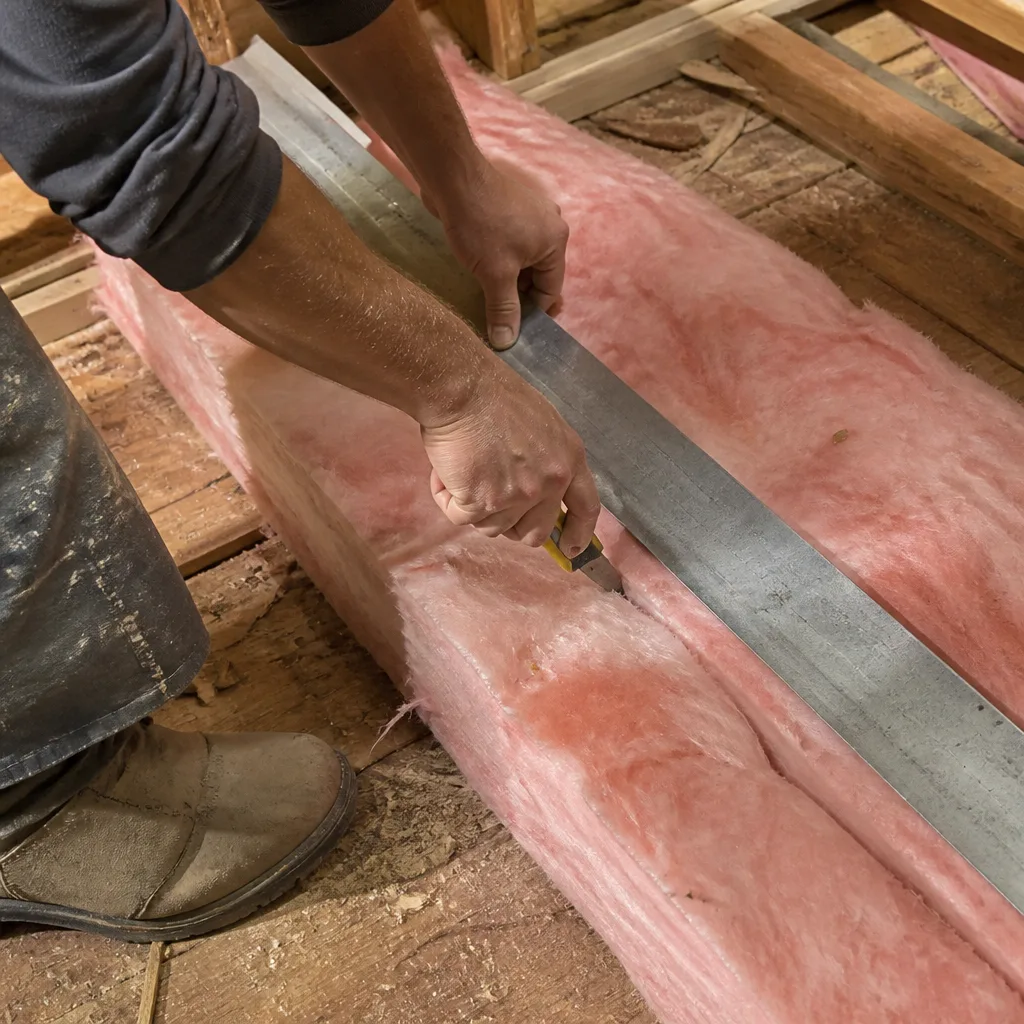
In Georgetown’s hot-humid climate, an unsealed wall cavity with blown-in insulation is meaningfully less effective than the R-value label suggests. Here’s why: insulation slows conductive heat transfer, but it doesn’t stop air movement. If conditioned air can leak around an electrical box, through a top-plate gap, or past a pipe penetration, it will – and in Georgetown summers, it will carry humidity with it, which is how you get moisture problems inside walls that had “new insulation” installed five years ago.
The blower-door test – a pressurization measurement where a calibrated fan is sealed into a doorway and the house is depressurized to 50 Pascals – gives a single number (CFM50, cubic feet per minute at 50 Pascals) that shows total building envelope leakage. We run this test before work starts and again after air sealing is complete, then publish both numbers in the job record. A Georgetown home built in 2005 might read 4,800 CFM50 before sealing. After sealing top plates, can lights, and wall penetrations, that same home might read 2,900 CFM50. That’s a 40% reduction in air exchange that insulation alone would not have produced.
For a deeper look at how Wall Insulation in Georgetown works from inspection through final documentation, the service page walks through the full process including what the pre-installation assessment covers.
How to Save on Wall Insulation in Georgetown
Saving money on wall insulation in Georgetown is less about finding the cheapest contractor and more about making sure you’re paying for the right scope the first time. A job that skips air sealing, uses under-density blown-in, or misses cavities will underperform for years before anyone figures out why the energy bills didn’t change. Here’s where real savings come from:
- Combine work with an existing remodel. If studs are already exposed for a kitchen update, bathroom renovation, or room addition, spray foam or batt insulation can go in at a fraction of the cost of a standalone retrofit. Coordinate the insulation scope before the drywall goes back up.
- Address attic air sealing and insulation at the same time. Wall insulation and attic insulation are more effective together than either is alone. Many Georgetown homeowners see the biggest energy impact when both are addressed in one mobilization, because the two sources of loss compound each other. A single crew mobilization also reduces total project cost compared to two separate visits.
- Check Oncor and Bluebonnet Electric rebate programs. Williamson County homeowners served by Bluebonnet Electric Cooperative may qualify for rebates on insulation upgrades that meet threshold R-value requirements. Oncor territory customers in parts of Georgetown have similar programs. Rebate amounts and eligibility change annually – verify current figures directly with your utility provider before budgeting.
- Get a second opinion on any existing written estimate. Envelope Insulation Co. offers a free second opinion on any written estimate. Bring us the scope and the number; we’ll tell you whether the material spec is appropriate for Georgetown’s climate zone and whether anything is missing. There’s no charge for this review and no obligation to hire us after.
- Don’t delete the air sealing line to cut the quote. It’s the most common way homeowners accidentally reduce results. A wall insulation job without air sealing in Georgetown will typically recover less energy savings and will not qualify for blower-door-verified performance documentation. The air sealing line is not overhead padding – it’s the step that makes the insulation work.
- Schedule during off-peak months. Late fall and early spring (October-November, March-April) tend to have more scheduling flexibility than peak summer months when attic and crawl space work dominates the schedule in Georgetown. More scheduling flexibility sometimes translates to slightly faster project timelines, though written pricing at Envelope Insulation Co. does not fluctuate by season.
For a free written estimate on our Wall Insulation services at your Georgetown home, call (254) 970-2136. A live person answers – not a voicemail, not a callback window. Wes Okafor leads the team and can review your home’s specific situation before any numbers are put on paper.
Georgetown Wall Insulation by Neighborhood – What We Actually See
Georgetown isn’t a uniform housing market, and wall insulation needs vary more than most homeowners expect depending on where they live in the city.
Sun City Georgetown is predominantly single-story and built between 1995 and 2015. Most homes here have 2×4 exterior walls and were originally insulated with R-11 or R-13 fiberglass batts that have, in many cases, slumped or settled. Dense-pack blown-in over existing batts is possible in some configurations and is evaluated on a cavity-by-cavity basis.
Wolf Ranch and Morningstar (newer, built from approximately 2015 onward) tend to have 2×6 framing and existing blown-in or batt insulation, but air sealing at electrical boxes and top plates was often inconsistent at construction. The blower-door numbers on these homes frequently surprise owners who assumed new construction meant a tight envelope.
Berry Creek and other established neighborhoods closer to the inner city often have homes built in the 1980s and early 1990s with minimal or degraded wall insulation. These are the projects that most benefit from a full inspection before choosing a method, because cavity conditions vary significantly house to house.
Historic Downtown Georgetown properties require the most careful assessment. Balloon framing – where studs run the full height of a two-story wall without fire blocks at the floor line – creates long continuous cavities that are drilled and filled differently than platform-frame construction. Some of these homes also have plaster walls rather than drywall, which affects patching decisions and adds to material cost.
Teravista sits in a part of Georgetown where proximity to the Brushy Creek floodplain means some homes have experienced minor moisture events. Wall cavities in these homes should be inspected with a moisture meter before any insulation is added or replaced. Installing over damp material is one of the few things that can make an insulation problem worse rather than better.
What You Receive When Envelope Insulation Co. Completes a Wall Insulation Job
This is worth stating explicitly because documentation is where insulation contractors differ most, and most homeowners don’t know to ask for it until after the job is done.
Before work starts, you receive a written price with a flat dollar amount, a written scope describing the method, the material brand, the target density, and the warranty terms. Under Haven Standard Clause 1, no work starts without this document in your hands. No verbal agreements, no “we’ll sort it out when we see it.”
After work is complete, you receive a Documented Photo Record showing cavity conditions before drilling, mid-installation progress, completed patches, and any areas that required additional air sealing. On jobs where a blower-door test was run, you receive the before and after CFM50 readings in writing – a single figure that shows the measurable performance change from the air sealing work.
The 365-Day Done Right Promise applies to every job. If something was missed, if a patch failed, if settled material left a gap that shows up in a follow-up thermal scan, we come back and make it right. This is a written warranty, not a verbal reassurance – it’s in the scope document you received before anyone started.
FAQs – Wall Insulation Cost in Georgetown, TX
How much does it cost to insulate walls in Georgetown without opening them?
Dense-pack blown-in insulation – the standard method for closed walls – runs $1.80 to $2.90 per square foot of wall area installed in Georgetown, including drilling, filling, and patching. For a home with 1,200 square feet of exterior wall area, that’s typically $2,160 to $3,480. Air sealing of electrical boxes and penetrations, which is completed before the blown-in step, adds $420 to $900 depending on the number of penetrations. Get a written price specific to your home by calling (254) 970-2136 – a live person will answer.
Is spray foam worth the extra cost for Georgetown walls?
Closed-cell spray foam costs $3.00 to $4.25 per square foot installed versus $1.80 to $2.90 for blown-in, but it achieves R-6 to R-7 per inch (compared to R-3.7 per inch for dense-pack cellulose), acts as its own vapor retarder, and adds racking strength to the wall assembly. In Georgetown’s Climate Zone 2A, the vapor retarder function is a real benefit in south- and west-facing walls. The math favors spray foam when the wall is already open – during a remodel, for example. For a closed-wall retrofit where drilling and patching is the only option, blown-in usually offers a better cost-per-R-value in most Georgetown applications. Call (254) 970-2136 and we’ll run the numbers for your specific wall configuration.
Does wall insulation actually reduce energy bills in Georgetown?
Yes, but the result depends on whether air sealing was done first. In Georgetown homes we’ve worked on, a wall insulation project paired with air sealing typically produces a measurable reduction in blower-door readings – for example, a home reading 4,500 CFM50 before work may read 2,600 to 3,000 CFM50 after combined wall air sealing and insulation. Energy bill reduction follows that improvement, though the exact dollar savings depend on your HVAC system, thermostat habits, and window conditions. We document the blower-door numbers on every applicable job so you have a verifiable before-and-after rather than an estimated percentage from a sales sheet.
How long does wall insulation installation take in Georgetown?
A typical Georgetown home with 1,000 to 1,500 square feet of exterior wall area takes one full day for dense-pack blown-in, including air sealing, drilling, filling, and patching. Larger homes, homes with brick veneer, or homes requiring significant air sealing work may extend to two days. Spray foam in open-wall applications is faster per square foot but requires a cure period before drywall installation. The written scope you receive before work starts will include the estimated project duration.
What permits are required for wall insulation in Georgetown, TX?
In Georgetown, adding insulation to existing wall cavities via the dense-pack method generally does not require a building permit. Work that involves opening and closing wall assemblies as part of a larger renovation, or that changes the wall’s fire rating, may require a permit depending on scope. Spray foam in specific applications has its own code requirements under the 2021 International Residential Code as adopted in Texas. Your written scope from Envelope Insulation Co. will identify any permit requirements specific to your project before work starts – we don’t leave that determination to the homeowner to figure out after the fact.
Key Takeaways
- Wall insulation in Georgetown runs $1.50 to $4.25 per square foot installed, with most existing-home dense-pack jobs falling between $2,160 and $3,480 for a typical 1,200 sq ft wall area.
- Air sealing is completed before insulation goes in – always. The blower-door numbers before and after document the result.
- Georgetown’s hot-humid Climate Zone 2A makes vapor management and wall assembly moisture control a real factor in material selection, not a theoretical one.
- Neighborhood and construction era matter: Sun City, Wolf Ranch, Berry Creek, and Historic Downtown Georgetown each present different wall configurations and different typical problem sets.
- A written price is delivered before any work starts. A Documented Photo Record and (where applicable) before-and-after blower-door readings are delivered when the crew leaves.
- The 365-Day Done Right Promise is a written warranty – not a verbal one.
For more context on the service itself, the home page covers Envelope Insulation Co.’s full building-envelope service line and the Haven Standard that governs every job.
Ready for a written price on wall insulation at your Georgetown home? Call (254) 970-2136. A live person answers. Wes Okafor and the Envelope Insulation Co. team have documented the before-and-after on thousands of homes in this market since 2016, and your written estimate costs nothing. There’s no voicemail loop, no callback window measured in business days – just a straight answer and a flat number you can hold us to.
Pricing reflects the Georgetown, TX market as of 2026. Written by Wes Okafor, Owner at Envelope Insulation Co. (operating as Topside Attic Insulation Georgetown), serving Georgetown since 2016. Topside Attic Insulation Georgetown offers free written estimates – call (254) 970-2136.
What Our Customers Say
"They photographed rodent damage in the old insulation that we had no idea about, and priced the exclusion work separately so we could decide."
- Harriet N."Crawl space encapsulation done properly. Photographs of the vapour barrier at every seam, and the damp smell in the hallway is gone."
- Ainsley P."Fixed price, clean work, and they hauled the old material away as agreed."
- Todd M.